AI Pen and Recorder: Redefining How We Capture, Understand, and Use Information
09 Jan 2026
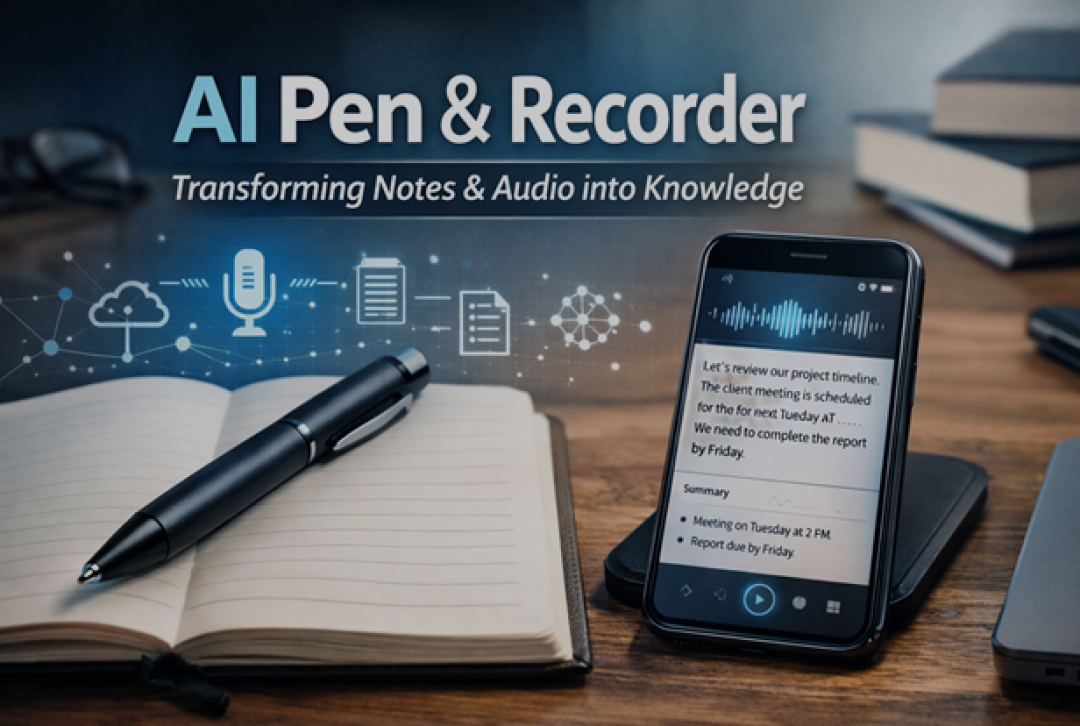
The way humans record information has evolved from handwritten notes to digital documents and voice recordings. AI pens and recorders represent the next stage in this evolution, combining traditional writing tools with artificial intelligence, speech recognition, and cloud computing. These devices do more than capture words—they interpret, organize, and transform information into usable knowledge. This article explores the technology behind AI pens and recorders, their real-world applications, benefits, challenges, and their role in shaping the future of personal and professional productivity.
Introduction
In academic, professional, and creative environments, capturing information accurately and efficiently is critical. Meetings, lectures, interviews, and brainstorming sessions often generate more information than can be manually recorded in real time. AI pens and recorders address this challenge by merging natural writing and speech capture with intelligent software that can transcribe, summarize, and organize content automatically. Rather than replacing human note-taking, these devices augment it—reducing cognitive load while improving accuracy and recall. Technology Behind AI Pens and Recorders AI pens and recorders integrate microphones, sensors, and AI-driven software into compact, portable devices. High-quality microphones capture speech with noise reduction, while motion sensors and digital ink technology track handwriting with precision. Artificial intelligence models then process this data using automatic speech recognition, natural language processing, and pattern recognition. Many AI pens synchronize handwritten notes with recorded audio, allowing users to tap on written text and replay the exact moment it was spoken. AI-powered transcription converts speech into editable text, while advanced language models can summarize long recordings, identify key topics, and highlight action items. Cloud connectivity enables cross-device access, storage, and continuous learning improvements.Practical Applications AI pens and recorders are increasingly used across education, business, healthcare, and creative fields. In classrooms and universities, they help students capture lectures accurately, revisit complex explanations, and create structured study notes. For professionals, these tools streamline meetings by producing searchable transcripts and summaries, reducing the risk of missed details and follow-up errors. Journalists and researchers benefit from accurate interview recordings paired with instant transcriptions, significantly reducing post-production time. In healthcare and legal environments, AI recorders support accurate documentation while allowing professionals to focus on the conversation rather than manual note-taking. For writers and creators, these devices act as idea-capture tools, preserving spontaneous thoughts before they are forgotten. Benefits of AI Pens and Recorders The most significant advantage of AI pens and recorders is their ability to enhance human memory and attention. By automating transcription and organization, they allow users to stay present during conversations and learning sessions. The combination of handwriting and audio improves recall and comprehension, while searchable digital records make information retrieval fast and reliable. These devices also improve productivity by reducing manual documentation time and minimizing errors caused by incomplete or rushed note-taking. Over time, they help build structured knowledge archives that can be reviewed, shared, and reused. Challenges and Considerations Despite their advantages, AI pens and recorders face certain limitations. Transcription accuracy can vary depending on accents, background noise, and language complexity. Battery life and storage capacity may restrict long recording sessions, and reliance on cloud services raises concerns about data privacy and security. Ethical and legal considerations around consent for recording conversations also require careful attention. Responsible use, transparent policies, and secure data handling are essential for widespread adoption. Future Outlook As AI models continue to improve, AI pens and recorders are expected to become more context-aware and autonomous. Future devices may offer real-time summarization, emotion detection, speaker identification, and deeper integration with productivity platforms. Advances in on-device AI will also reduce dependence on cloud processing, improving privacy and responsiveness. In the long term, AI pens and recorders could evolve into intelligent personal knowledge assistants—tools that not only capture information, but actively help users understand, connect, and apply it. Conclusion AI pens and recorders represent a meaningful advancement in how information is captured and managed. By combining natural writing and speech with artificial intelligence, they bridge the gap between human thinking and digital organization. While challenges related to accuracy, privacy, and usability remain, the direction of innovation suggests that AI pens and recorders will become essential tools for learning, collaboration, and knowledge work in an increasingly information-rich world.